
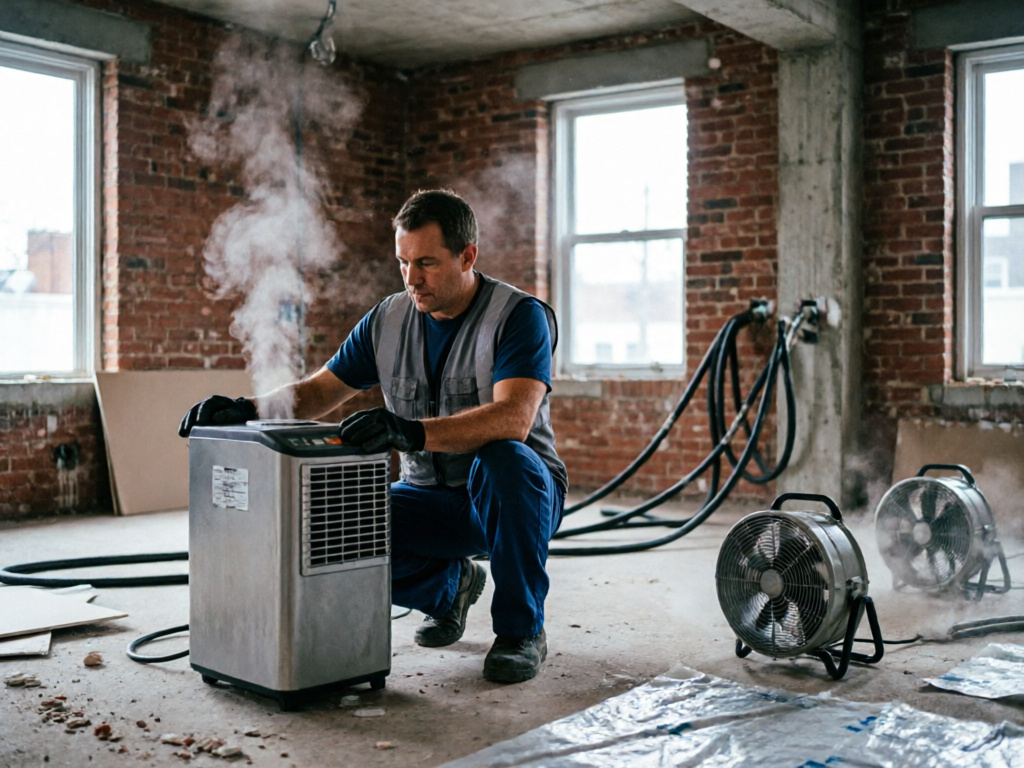
Buffalo's older housing stock in Erie County often features plaster walls and tight basements that trap moisture after ice-dam leaks or snow-melt intrusion along I-90 and NY-5. Heavy lake-effect snow followed by rapid thaws creates recurring water events near landmarks such as Canalside and Delaware Park, where cold temperatures slow natural evaporation. Specialized drying equipment must therefore target hidden pockets in wood framing and masonry common to homes around Buffalo City Hall and the Albright-Knox Art Gallery, while high regional humidity from Lake Erie extends required dehumidification cycles.
Structural Drying and Dehumidification in Buffalo — What We Handle
- ✓Equipment must operate efficiently in sub-zero conditions created by lake-effect snow that standard drying methods cannot address.
- ✓Access routes along I-190 and NY-33 require compact gear suited to narrow streets in historic neighborhoods.
- ✓Moisture mapping focuses on plaster-and-lath systems prevalent in Buffalo architecture rather than modern drywall.
Structural Drying and Dehumidification Services We Offer in Buffalo
✓Moisture Mapping and Assessment
Pin and infrared scanning of walls, floors, and ceilings to locate hidden water pockets before drying begins.
✓Industrial Dehumidifier Deployment
Placement of commercial LGR units sized for Manhattan humidity loads to pull moisture from porous materials.
✓Air Mover Circulation Setup
Strategic positioning of high-velocity fans to create directed airflow across wet surfaces without spreading contaminants.
✓Wall Cavity Drying
Drilling or vent insertion to dry insulation and framing behind finished walls in Upper East Side brownstones.
✓Hardwood Floor Drying
Slow, monitored drying of strip and plank flooring to prevent cupping after leaks near Times Square buildings.
✓Concrete Slab Moisture Extraction
Use of weighted extractors and desiccants on slab-on-grade floors common in New York County commercial spaces.
Old masonry and plaster walls common around the Empire State Building and Central Park retain water differently than modern drywall, requiring slower drying cycles to avoid cracking or salt efflorescence. In humid subtropical summers, ambient moisture levels above 60 percent can push drying times past five days even with high-capacity equipment, while winter freezes in unheated Upper East Side basements create ice lenses that later thaw and re-wet cavities.
We place low-grain refrigerant dehumidifiers and air movers in patterns that pull moisture through the least resistant paths first, monitoring with pin and pinless meters at multiple depths. Times Square area commercial spaces often need temporary containment to protect adjacent tenant areas from dust and humidity migration during the process.
How It Works in Buffalo
- 1
On-Site Evaluation
Technician measures moisture at multiple depths and identifies affected materials while documenting conditions for insurance.
- 2
Equipment Placement
Dehumidifiers and air movers are positioned based on building layout and current outdoor humidity levels.
- 3
Daily Monitoring
Readings are taken each visit to confirm moisture reduction and adjust airflow or dehumidification capacity as needed.
- 4
Final Verification
All surfaces are retested to ensure they meet drying standards before equipment removal and handoff.
Serving All of Buffalo
We regularly handle structural drying and dehumidification jobs near:
- 📍Buffalo City Hall
- 📍Albright-Knox Art Gallery
- 📍Canalside
- 📍Delaware Park
Structural Drying and Dehumidification Pricing in Buffalo
Upfront quotes provided after inspection; rates reflect equipment runtime and square footage. Open Mon–Fri 8am–6pm, Sat 9am–2pm.
Want the full picture of this service? See our Structural Drying and Dehumidification page, or everything we do in Buffalo, NY.